 Train simulator · Official website
About this informationImages and descriptions may show work in progress or earlier versions and may differ from the current game.
While driving
After I repeatedly pressed the buzzer at a stop, the doors would not close or reopened while closing.
Repeated short buzzer signals mean that a previous signal is cancelled or an obstruction is present. If sent while the doors are closing, the conductor interprets them as an obstruction on the driver's side and reopens the doors, for example if a late passenger is boarding where only the driver can see. If the doors have reopened but there is no obstruction, send one slightly longer buzzer signal to indicate that it is safe to close them.
The conductor will not close the doors until the necessary conditions are met, such as the departure indication and a cleared signal.
Due to the way the game is programmed, repeated buzzer signals will not reopen doors once they are fully closed.
Why does the station departure announcement play before I have stopped?
Tatehama Electric Railway's automatic station announcements, including departure announcements, are linked to the PTC train traffic control system. In the game, a timer starts when a train occupies the platform track circuit and the preceding track circuit is clear. Depending on the conditions, the announcement may play before the train stops.
At Tatehama, why does the entry signal show route 4 when the train enters passenger platform 5?
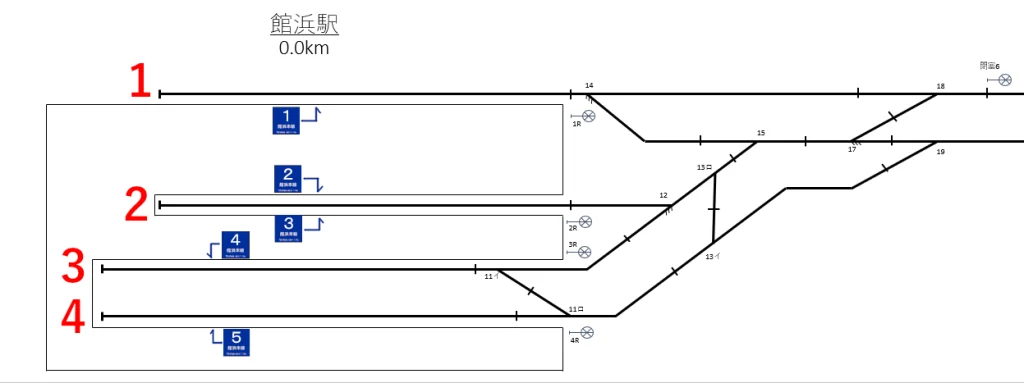
Operational track numbers (red numbers in the image above) can differ from passenger platform numbers (numbers on blue backgrounds). At Tatehama, operational track 2 has platforms on both sides and serves passenger platforms 2 and 3. This causes the subsequent numbers to differ.
The Japanese automatic announcements also reflect this: Tatehama uses the term noriba for passenger platforms, while stations where operational and passenger numbers match use bansen.
Why are signal speed limits 55km/h for caution and 80km/h for reduced speed?
Signal call-out markers are generally placed 300m before signals on sections with a 110km/h maximum speed. Early in development, train deceleration was relatively low, so slowing from 110km/h to 70km/h before a reduced-speed signal was not possible. The achievable speed was calculated as 80km/h. The caution limit was set using the same approach. The relatively long block sections were considered sufficient for these limits.
Some railways, referred to here as K Railway and M Railway, have higher signal speed limits than Tatehama Electric Railway.
Why are there six service-brake steps plus a speed-holding notch?
The original design had seven steps, B1–B7, without a speed-holding notch. When it became clear that mountain sections needed speed holding, B1 was replaced with that function and B2–B7 were reassigned as B1–B6.
Some real operators, referred to here as H Railway and O Metro, also use six steps.
Some front lights are off, or only one is lit.
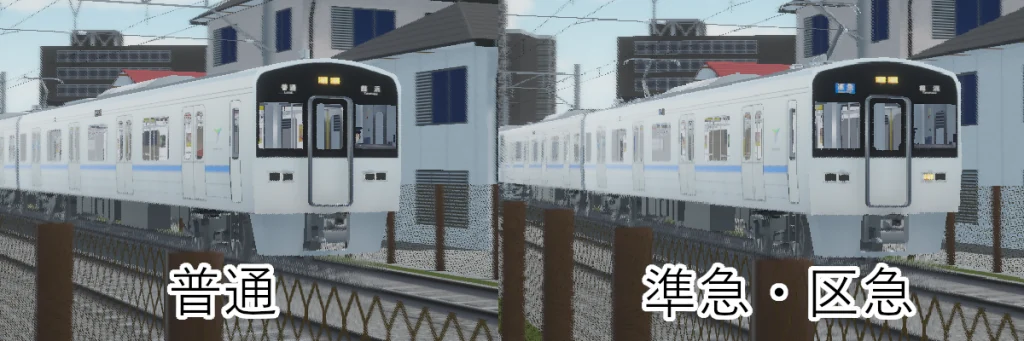
The two lower lights (the two outer lights on the 5300 and 50000 series) are service indicator lights. Their pattern varies by train category. On Tatehama Electric Railway:
• Local: both off
• Semi-express and section express: one lit
• Express, rapid express, limited express and deadhead: both lit
These are the patterns used in the game.
Reference: Hankyu Railway's official Twitter account (Japanese)
Why is the six-car stopping point outside the platform at Hagoromobashi (羽衣橋) on an upbound service?
Hagoromobashi's platform is only four cars long, so a six-car train stops with two cars extending beyond it. Doors on those cars are kept closed; this is selective door operation.
Conductor Duty
The train stopped after I repeatedly pressed the buzzer.
Repeated short buzzer signals indicate an emergency, so the driver responds by applying the emergency brake.
Why does a six-car downbound service stop short at Hagoromobashi (羽衣橋)?
Hagoromobashi's platform is only four cars long, so a six-car train stops with two cars extending beyond it. Doors on those cars are kept closed; this is selective door operation.
Why did I receive a large penalty for departing just a few seconds early?
In Japan, railway regulations prohibit departures before the time shown in the timetable. An early departure that crosses a minute boundary, for example departing before a scheduled time of 12:34:00, at 12:33:58, also conflicts with the departure time given to passengers. TRAIN CREW therefore applies an in-game HP penalty.
Driving ratings
Are the ratings based on real train-driver assessment standards?
No. They are game scoring rules designed to let players compare and compete with one another.
Previously, both additive and subtractive rating systems were used. Following feedback that this was confusing, they were unified into an additive scoring system.
Why did I receive the standard-braking bonus even though I reapplied the brakes?
In the current implementation, releasing the brakes at 50km/h or above, or at or above the speed limit minus 10km/h, resets the count. For example, the latter threshold is 15km/h under a 25km/h restriction.
This approach is used because it is difficult to determine exactly when a braking sequence begins. The game also judges a notch only after it has been held for at least 0.5 seconds, so changes made more quickly may not be counted.